
Veteran-Owned · Florida Licensed · Southwest Florida
Commercial Solar Installation in Florida
S7 Solar provides commercial solar installation Florida businesses can plan around their property, electrical demand, operating hours, and long-term energy goals. Our commercial solar installers in Florida coordinate system design, structural considerations, permitting, installation, inspections, and utility interconnection for qualifying light-commercial projects.
✓ Property-specific recommendations, not preset packages
✓ Florida Solar Contractor License #CVC57136
✓ Clear scope, permitting, and post-install support
Commercial feasibility before proposal
Start with the building, operating profile, and decision criteria.
A commercial assessment should establish ownership, electricity use, operating hours, roof and structural information, electrical service, critical loads, and the records required for a defensible model.
What a useful assessment covers
- Facility information. Address, ownership, roof records, electrical service, available space, and planned building changes.
- Energy profile. Bills, interval data when available, operating hours, demand charges, and critical loads.
- Decision model. Scope, production assumptions, approvals, schedule drivers, costs, and independently reviewed incentives.
Service planning for Southwest Florida
Property conditions and approved scope guide each commercial solar recommendation.
01
Dual-licensed: Solar Contractor + General Contractor (#CGC1530053)
02
Current incentive assumptions should be reviewed with a qualified advisor
03
Financial models use property-specific costs and operating assumptions
04
Project timeline provided after feasibility and approval requirements are known
05
Custom commercial system design and engineering
06
All permits, utility interconnection, and inspections handled
A straightforward process
From feasibility review to commercial commissioning.
01
Screen the opportunity
We review facility records, energy use, ownership, roof and structural conditions, and project goals.
02
Develop the approved scope
Engineering, equipment, financial assumptions, permits, utility requirements, and schedule are documented.
03
Install and commission
The approved system is installed, inspected, interconnected, tested, and handed over with operating information.
DETAIL 01
Commercial Solar Panels for Florida Businesses
Commercial solar panels Florida businesses install are often a strong fit for owner-occupied buildings and light-commercial properties with suitable roof or ground space and substantial daytime electricity use. Offices, retail facilities, workshops, warehouses, professional buildings, and community facilities may offset a portion of purchased utility power when production aligns with operations. A commercial solar installation requires analysis of interval usage, utility tariffs, demand charges, shade, roof condition, structural capacity, electrical service, ownership plans, and available installation area. Businesses can review our solar panel installation process for the core design, permitting, and interconnection steps that also inform commercial planning.
DETAIL 02
Commercial Solar Battery Systems
A commercial solar battery system can support selected critical circuits when utility power fails and can also help a business manage when stored solar energy is used. Depending on battery output, capacity, and facility design, backup may cover security and access systems, communications, internet equipment, point-of-sale systems, refrigeration controls, emergency lighting, or other essential equipment. Battery backup for businesses must be designed around verified loads and runtime priorities; a single battery system should not be assumed to power an entire facility, large HVAC equipment, production machinery, or every circuit. Our Solar + Battery Systems service explains the basic relationship between generation, storage, controls, and backup operation.
DETAIL 03
Solar for Offices Warehouses and Commercial Buildings
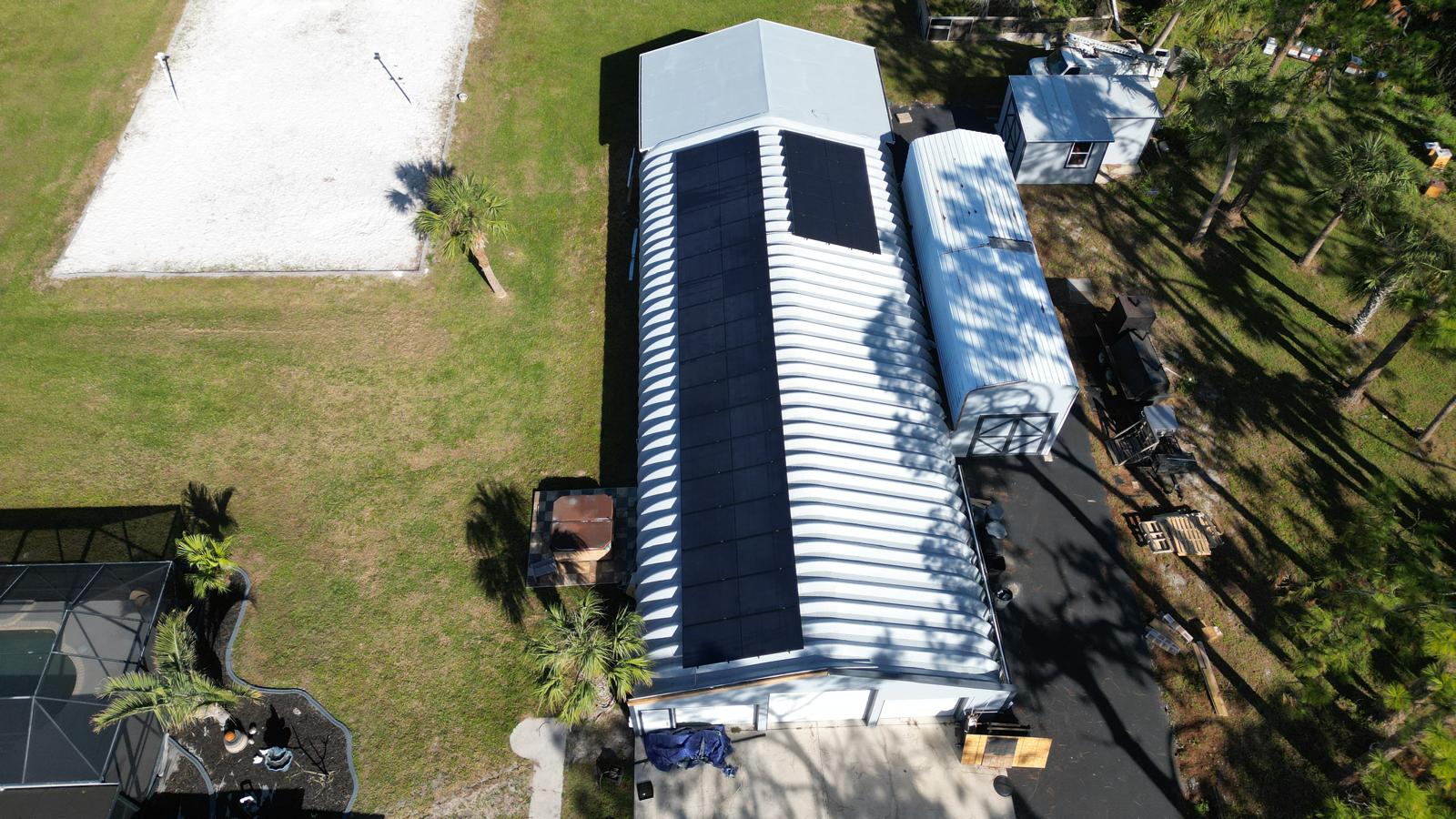
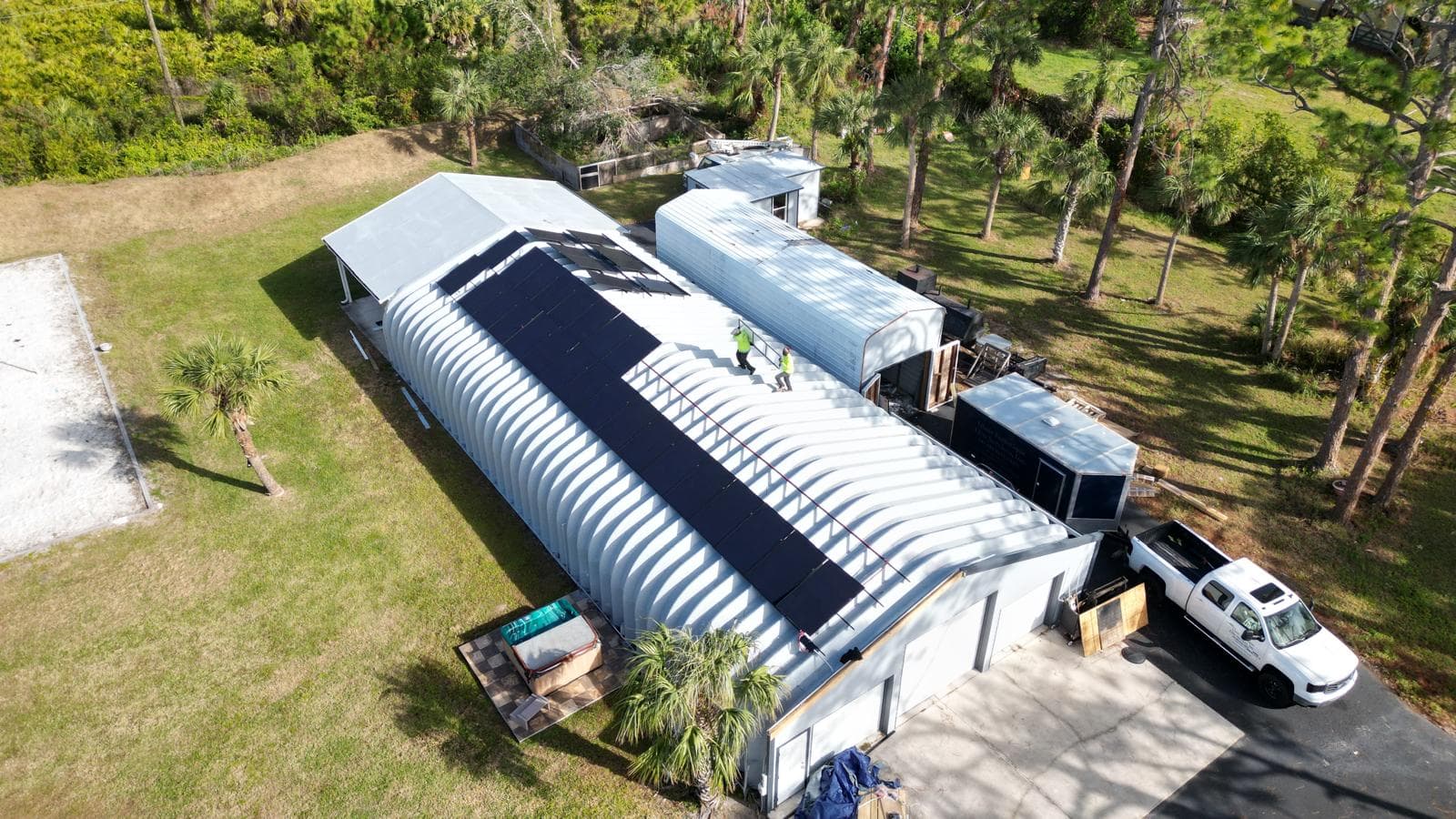
Solar for office buildings in Florida is commonly designed around weekday operating hours, HVAC demand, computer and lighting loads, tenant arrangements, and available roof area. Solar for warehouses in Florida may benefit from broad roof surfaces, but structural loading, roof age, drainage, penetrations, fire access, equipment zones, and electrical-distribution distance still require review. Metal, membrane, tile, and other roof types call for different attachment and waterproofing details. Each facility also has its own demand profile, service voltage, panel configuration, and expansion plans, so commercial designs cannot be copied from one building to another.
DETAIL 04
Business Continuity During Florida Power Outages
For many businesses, storage is about operational resilience as well as energy savings. A planned backup system may keep communications available, protect refrigerated inventory, maintain security, support essential transactions, or provide time for an orderly shutdown during a hurricane, grid failure, or other emergency. We identify critical circuits, startup loads, required runtime, recharge options, and acceptable interruptions before selecting equipment. Longer outages or large continuous loads may call for load controls, multiple batteries, a generator, or a coordinated hybrid plan rather than battery storage alone.
DETAIL 05
Licensed Solar and General Contractor Capabilities
S7 Solar holds Florida Solar Contractor License #CVC57136 and Florida General Contractor License #CGC1530053. Those credentials allow our team to evaluate the solar scope alongside structural work that may be associated with a commercial installation, subject to engineering, permitting, and project requirements. We coordinate roof conditions, supports, equipment locations, access, electrical work, and related construction details instead of treating the array as an isolated component. See our commercial project photos for examples of completed work and installation conditions.
DETAIL 06
Current Commercial Solar Incentives
Commercial solar and storage projects may qualify for federal tax credits, depreciation treatment, grants, financing programs, or utility offerings, but programs, rates, deadlines, bonus requirements, and business eligibility can change. Any financial model should use current program guidance and property-specific assumptions. Business owners should confirm tax treatment and eligibility with a qualified tax professional or financial advisor before relying on an incentive in a purchase decision.
Commercial Solar FAQs
Can commercial solar reduce business electricity costs?+
Can batteries keep a business operating during an outage?+
Are warehouses suitable for solar panels?+
How long does commercial solar installation take?+
What incentives are available for commercial solar?+
Related Solar Services
Solar Panel Installation
Residential solar panel installation in Venice & SW Florida. Licensed FL contractor #CVC57136. Tax incentives may apply. Free consultation.
Learn more →⚡Solar + Battery Systems
Solar and battery systems in Southwest Florida with property-specific production, storage, outage planning, permits, and monitoring from S7 Solar.
Learn more →🔧Solar Repairs & Maintenance
Solar panel diagnostics, repair, and maintenance in Southwest Florida for qualifying existing systems. Licensed contractor assessment and service planning.
Learn more →Commercial Solar in Southwest Florida
S7 Solar provides commercial solar across Southwest Florida. Select your city to learn more about solar services in your area.